
In early 2014 Tokyo-based MtGox was the largest bitcoin exchange in the world. It dominated the industry, processing an estimated 70-80% of the world’s bitcoin trading.
Kolin Burges found himself unable to withdraw his funds from MtGox in early February 2014 and could not get any meaningful response from their customer service. He flew from London to Tokyo to visit their headquarters to find out what was going on there and why his money was being held. In Tokyo with the help of a local MtGox customer he met with the Wall St Journal and visited the MtGox offices in Shibuya. He was refused his request to speak to CEO Mark Karpeles or anyone else.
That evening at the Tokyo Bitcoin meetup he met another MtGox customer Aaron who was in a similar situation as well as a reporter from CoinDesk. The next morning, Friday 14th Feb 2014, Kolin and Aaron began a protest in the melting snow outside the MtGox office with the Wall Street Journal and CoinDesk in tow. The initial aim was to speak to the CEO as he arrived at the office because this was the only avenue left open to them to communicate with the company. This was not the first protest outside MtGox, another customer from Australia had done something similar a few days earlier.

When Karpeles came along, Kolin was able to stop and confront him. His requests for the return of his bitcoins were unsuccessful as expected and Karpeles did not provide an adequate explanation. He would not answer questions about whether MtGox still possessed the customer bitcoins. Eventally he escaped inside, warning Kolin not to go in, then stood inside the doors for 20 minutes watching. The scene was filmed by the journalists and when the videos were published they brought a whirlwind of attention. The confrontation with Karpeles went on to become one of the most memed and infamous scenes in bitcoin history. Thus began the MtGox protest and its support from the community.
By the end of the first day the Financial Times and Japanese state broadcaster NHK had also been to the protest site and the buzz on the internet had led to hundreds of messages, many donations, and even an offer of a place to stay. The protest was fast gaining attention around the world.

That weekend, MtGox arranged an “unofficial” secret meeting with Kolin. They demanded that the protest end and ominously told him if it continued then MtGox would collapse and he and the other customers would lose all their money. They however were claiming publicly that the reason withdrawals were not working was simply technical problems.
At the same time they also secretly sent a document to other bitcoin exchanges mentioning a 744,000 bitcoin shortfall and begging for 200,000 bitcoins to fund a scheme to cover it over and keep MtGox running. They claimed that a collapse of MtGox could mean the end of bitcoin and so it was actually in the other exchanges’ best interests to send them hundreds of thousands of bitcoins. Their grand plan included rebranding MtGox as “Gox” as a means to convince customers to accept their losses and continue to use the exchange!

The following day the protest continued amid more signs of MtGox’s desperation. An employee came out as the protesters arrived and demanded to know why they were back after they’d been told to end the protest. Later in the day, that same employee professed concern that the protesters looked cold and invited them to relocate the protest inside the MtGox office (where there would incidentally be no media to witness it). They declined that generous offer.

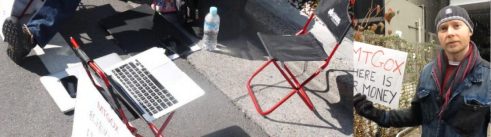
That week, miniature chairs were donated and the protest evolved into more of a pop-up media station. A great deal of press attention gradually built up over that time. The story transcended the financial and tech media into the mainstream, with many of the world’s most influential newspapers, magazines and TV stations turning up to cover the story. Over time the protest became more high tech, with the focus shifting from protesting to communicating with the media and the bitcoin community. A live video feed introduced on Wednesday 19th Feb began drawing several hundred simultaneous viewers and Aaron began a new role conducting live video Q&A with the internet. Kolin focused on social media, emails and contacting the media.
After a couple of days, MtGox moved out of the building due to the media attention and what they later claimed were security concerns. They sneaked out at night with nobody watching. When Aaron announced in a press conference the next day that MtGox had left the building, the bitcoin price on MtGox immediately fell by 45%. The protest kept running in situ and building more and more media momentum.


MtGox blamed the protesters for slowing down their fixing of the “technical problems”, effectively trying to pass on the blame for the withdrawal issues. There were in reality no technical problems other than the fake ones in their cover story. What they were really doing behind closed doors was racing against time to get their hands on 200,000 bitcoins before the game was up and the CEO inevitably went to jail. The growing global attention focusing on their doors was bringing that moment of reckoning closer and that’s why they feared the protest so much.


On Friday 21st Feb, the Tokyo police arrived to shut the protest down. Around eight bitcoiners were peacefully visiting and chatting when they arrived. The right to peaceful assembly and protest is guaranteed in the Japanese constitution. The police’s claim was that this was an assembly which caused public disturbance, which was a sharp bending of the truth. Effectively it seemed there was a right to assemble and protest as long as there was no assembling or protesting. They demanded all the cameras be turned off and stop filming them but didn’t notice there were still 3 or 4 cameras trained at them the whole time including the live internet feed. After a very long period of discussion with Aaron via the protest’s interpreter, they forced everyone to disperse and (arguably unlawfully) threatened Kolin and Aaron with arrest if they came back another day. It seemed like this could be the end of the protest in its current form.
The protesters later went to the police station to clear a way to allow a peaceful protest of two people, but the police would not agree to it. If they were arrested for an unknown period of time, however unlawful that arrest might be, it could have meant a permanent end to the protest. The police knew from the TV what was going on there so perhaps they wanted to keep scandals away from their territory, or perhaps it was a more political decision.

The Japanese media were generally late to the party when it came to covering MtGox or the protest. Bitcoin was not something they knew much about at the time. When the story was published in the Asahi Shimbun, the second largest newspaper in the world, the street exploded with Japanese TV cameras and several dozen reporters. It was somewhere inbetween a movie set and a war zone. The Asahi journalist had warned that this would happen once they published but the protesters thought he was exaggerating. They were there to cover the protest as MtGox had long since fled the building. The Shibuya police were not going to dare tackle this new mob of reporters and so the police were never seen there again.


These pics were taken from a camera which Kolin held up next to his protest sign (see bottom right pic below)
For 2-3 days Kolin was spending nearly every waking hour doing interviews. The MtGox situation was now being covered by seemingly nearly all major newspapers and TV stations around the world. This was the big media debut for bitcoin on the world stage, but it was a very negative one which would shape the mainstream perception of bitcoin for years to come. The disinformation put out by MtGox about bugs in bitcoin being responsible for the chaos were widely repeated and echoed for years.


The Japanese government had become publicly involved with the situation from Friday 21st onwards, the day the police arrived. Statements were made by the Bank of Japan, the Financial Services Authority (FSA), the Ministry of Finance, and the central government. It became a large political embarrassment for Japan in front of the world. The FSA arguably deserved some of the blame as MtGox had played fast and loose with the fiat banking laws on their watch. They publicly claimed MtGox was not within their jurisdiction, which was patently false, and later efforts to investigate their actions were blocked.

On Friday 28th Feb 2014, two weeks after the start of the protest, MtGox finally announced at a press conference that they had lost the customer bitcoins to a hacker and they shut down their operations forever. Behind closed doors they had lost 850,000 coins in total, 7% of all the bitcoin in the world.
Sometime in the few days after this, Karpeles found 200,000 customer bitcoins in an old wallet, coincidentally the exact amount they had been desperately seeking to fund the scheme to keep MtGox running long-term. However it was now too late to continue with their scheme. Karpeles attempted to use the customer bitcoins to reopen MtGox via Civil Rehabilitation laws but thankfully the Japanese courts were not having it.
History and the fate of those 200,000 bitcoins may have been very different had the media pressure not forced MtGox into a prompt closure. The bulk of those 200,000 bitcoins was returned to customers 10 years later after a protracted bankruptcy process.
After the fall of MtGox the Japanese government brought in strict new crypto laws to avoid such situations in the future. The new laws successfully protected the money of Japanese users of FTX when it collapsed many years later.
In 2017 the US government ordered the arrest of Russian national Alexander Vinnik while travelling in Europe. He was believed to be the thief and launderer of the missing MtGox coins. Vinnik was jailed in Europe and the US for 8 years before the Trump administration exchanged him with Russia in a high profile prisoner swap.
Acknowledgements
Other notable figures involved in the protest were: Coinsearcher who was the original MtGox protester and began the first protest outside the office a few days before we did, but sadly went home to Australia before these events. Karl-Friedrich Lenz, a banking law professor who was an instrumental figure in the background, he set up the WSJ and CoinDesk coverage and brought us chairs, supplies, legal advice and moral support and then wrote a book. Guest protester Trevor joined us wearing an iron mask and added some flavour and much-needed angst. Jon Southurst @CoinDesk and Takashi Mochizuki @WSJ kickstarted us with the initial media coverage. Yuji was our interpreter with the police. Duncan Ridgely provided the blog website. Matthew Dumas offered a place to stay. Yayoi, Roger Ver and others brought teas and coffees. Countless people on Reddit tipped us dogecoin for coffees etc. And there was Dexter the toddler protester. Thanks to all the others who visited, donated, or offered support whether offline or online.


